Introduction
Artificial Intelligence has become one of the most transformative technologies of the modern era. From search engines and recommendation systems to healthcare, banking, online shopping, and autonomous vehicles, AI is now deeply integrated into our daily lives. Whether you’re asking ChatGPT a question, receiving personalized movie recommendations, or unlocking your smartphone using facial recognition, Artificial Intelligence is quietly working behind the scenes to make these experiences faster, smarter, and more efficient. As AI adoption continues to grow across industries, AI Evaluation has become equally important to ensure these systems remain accurate, reliable, secure, and capable of delivering consistent results in real-world applications.
As AI adoption continues to grow, businesses are increasingly relying on intelligent systems to automate repetitive tasks, improve decision-making, enhance customer experiences, and reduce operational costs. However, building an AI model is only one part of the development process. A model that performs well during training doesn’t automatically guarantee reliable performance in real-world situations.
Once an AI system interacts with real users, it may encounter questions, scenarios, or data that were never included in its training. In such cases, the model can generate inaccurate responses, make incorrect predictions, produce biased results, or behave inconsistently. These issues can reduce user trust and, in critical industries such as healthcare or finance, may even lead to serious consequences.
To avoid these risks, developers thoroughly test every model before deployment. Instead of evaluating a model based only on how quickly it generates answers, they measure its overall quality, reliability, safety, fairness, and ability to perform consistently across different real-world situations.
This testing process is known as AI Evaluation.
It helps researchers, developers, and organizations understand whether an Artificial Intelligence model is ready for practical use. By identifying weaknesses early, improving performance, and reducing potential risks, evaluation ensures that AI systems deliver accurate, dependable, and trustworthy results.
In This Guide, You’ll Learn
After reading this article, you’ll clearly understand:
- What AI Evaluation means.
- Why it has become an essential part of AI development.
- How AI models are tested before deployment.
- Different evaluation methods used by researchers and technology companies.
- The most important performance metrics used to measure AI quality.
- Real-world applications across different industries.
- Common challenges developers face during evaluation.
- Best practices for building reliable AI systems.
- Future trends shaping AI testing and model assessment.
Whether you’re a beginner, student, developer, digital marketer, or business owner exploring Artificial Intelligence, this guide will help you understand how modern AI systems are tested before they reach millions of users.
What Is AI Evaluation?
Imagine a student preparing for an important final examination. The student spends months attending classes, studying different subjects, and solving practice questions. However, no one can confidently judge the student’s knowledge until an actual exam measures how well those concepts have been understood and applied.
Artificial Intelligence follows a similar process.
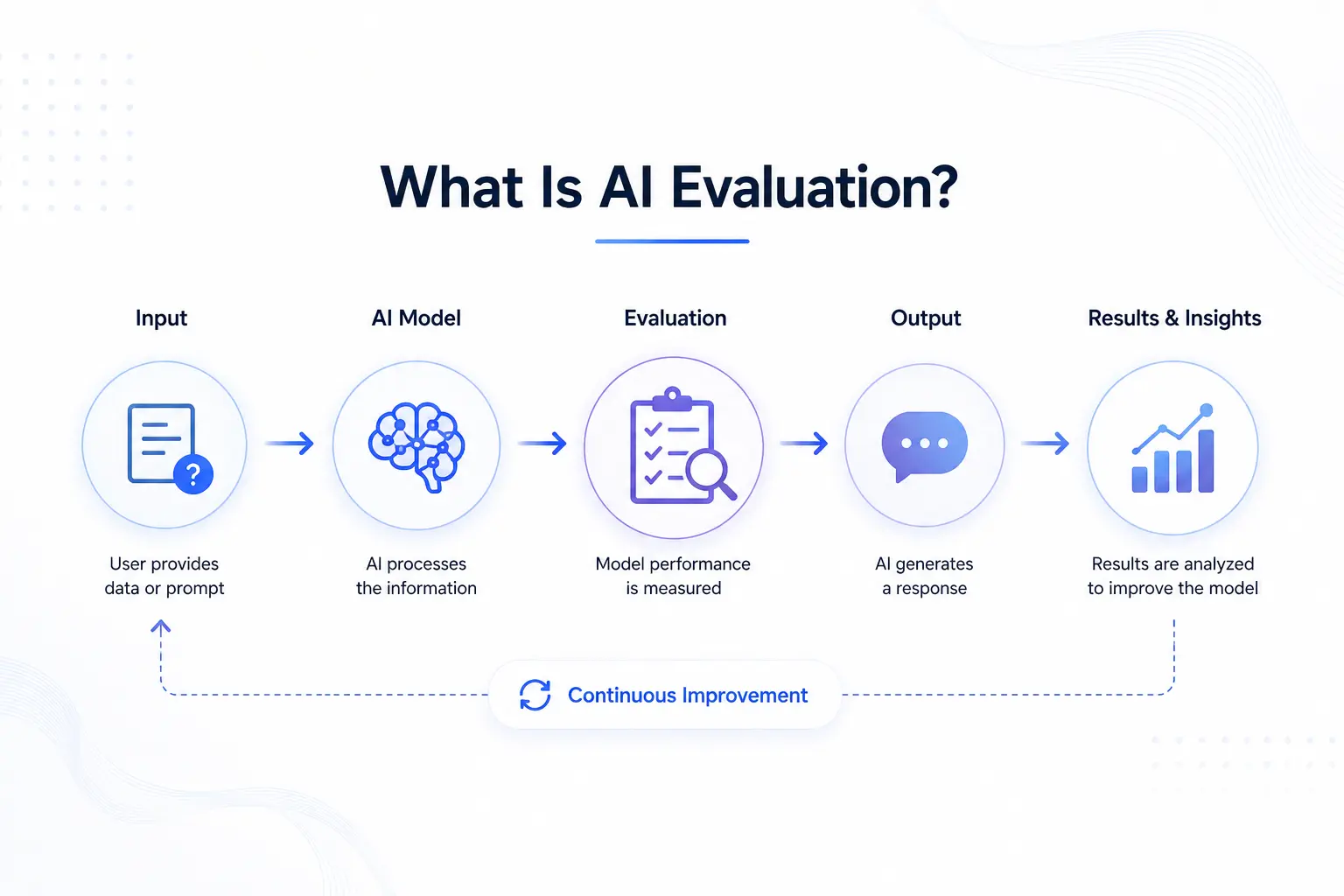
During development, an AI model learns from massive amounts of data to recognize patterns, understand language, make predictions, or generate meaningful responses. This learning phase is known as training. Although training teaches the model how to perform specific tasks, it doesn’t guarantee that the same level of performance will continue when the model encounters new users or unfamiliar situations.
For this reason, developers perform a comprehensive testing process before deploying any AI system. They examine how accurately the model responds, whether its predictions remain consistent, how efficiently it handles different types of inputs, and whether it produces fair, reliable, and safe outputs under various conditions.
In simple terms, AI Evaluation is the process of measuring and validating the performance of an Artificial Intelligence model using predefined datasets, benchmark tests, automated tools, and human feedback. The primary goal is to determine whether the model is accurate, dependable, efficient, secure, and ready for real-world deployment.
Unlike traditional software that follows fixed programming rules, AI systems make decisions based on patterns learned from data. Because of this, a model may perform exceptionally well in one scenario while struggling in another. Proper evaluation helps developers identify these weaknesses before they impact actual users.
For example, a customer support chatbot should provide relevant answers, a medical AI system should assist doctors with accurate diagnoses, an e-commerce platform should recommend products based on customer preferences, and a self-driving vehicle should correctly identify roads, pedestrians, traffic signs, and surrounding vehicles. Even small errors in these
applications can affect user experience, reduce business credibility, or create serious safety risks.
That is why evaluation is considered one of the most critical stages of the Artificial Intelligence development lifecycle. Rather than assuming a model is intelligent simply because it generates responses quickly, developers verify whether those responses are accurate, reliable, consistent, and genuinely useful in practical
Why Is AI Evaluation Important?
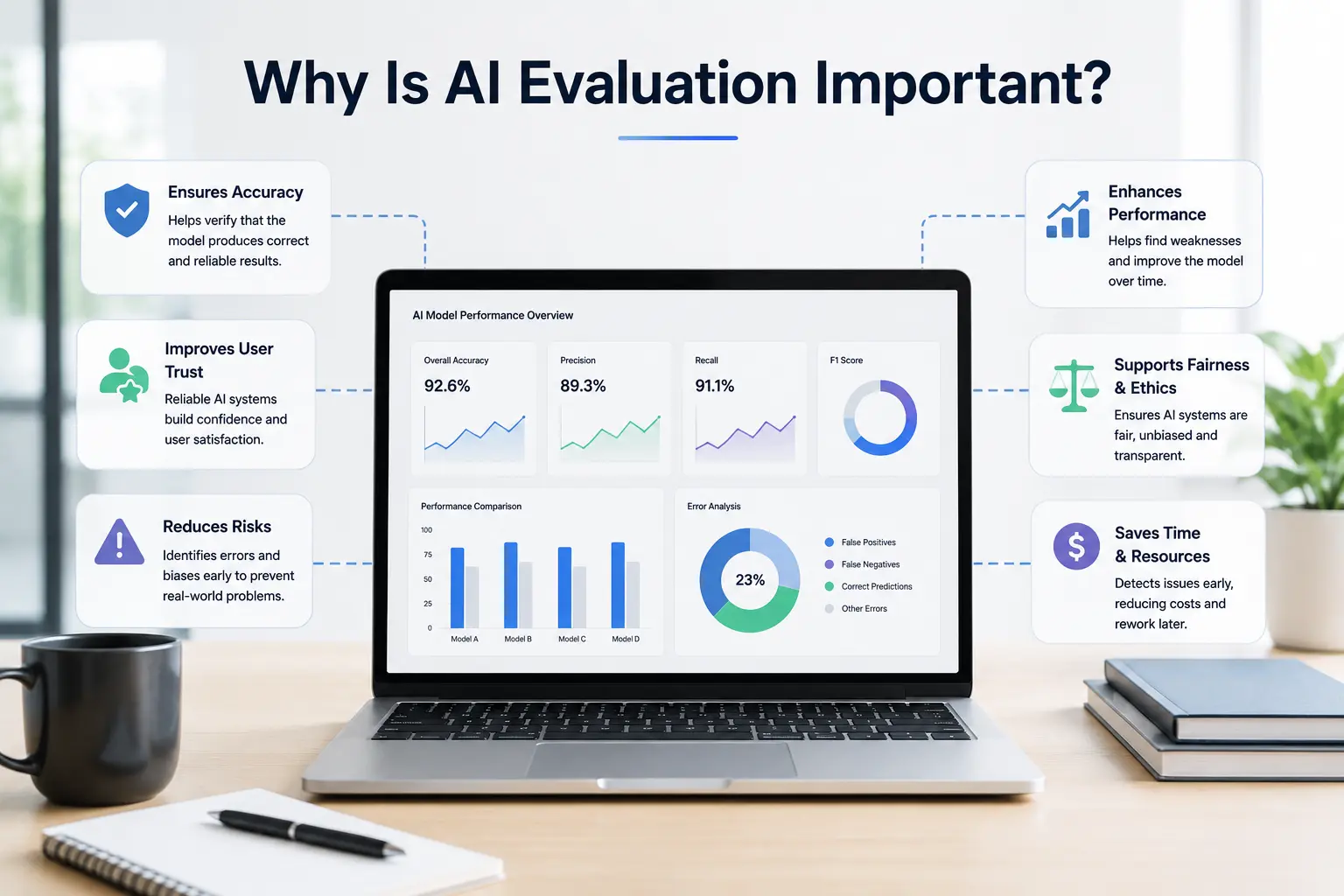
As Artificial Intelligence becomes more deeply integrated into everyday life, users expect AI systems to deliver accurate results, reliable recommendations, and safe interactions. Businesses also depend on AI to automate complex tasks, improve productivity, reduce operational costs, and enhance customer experiences. Even a small error in an AI-powered application can reduce user trust, damage a company’s reputation, or create serious risks in industries such as healthcare and finance. This is why AI Evaluation has become an essential part of responsible AI development, helping organizations verify that their models perform accurately, fairly, and consistently before deployment.
Below are some of the key reasons why evaluating AI models is so important.
1. Measures Model Accuracy
The primary purpose of evaluation is to determine how accurately an AI model performs its assigned task. Whether the model classifies images, translates languages, predicts customer behavior, or answers user questions, developers need objective evidence that the generated results are correct and dependable.
Accurate models improve user satisfaction, reduce costly mistakes, and provide organizations with greater confidence before deploying AI systems in real-world environments.
2. Detects Errors Before Deployment
Even a well-trained AI model can produce unexpected results when exposed to new or unfamiliar data. Thorough testing helps developers identify incorrect predictions, inconsistent responses, hidden weaknesses, and potential failures before the system reaches end users.
Detecting these issues during development is significantly faster, less expensive, and far less risky than fixing them after deployment.
3. Improves Reliability
Users expect AI systems to perform consistently every time they interact with them. A dependable model should produce similar-quality results when given similar inputs, regardless of when or where the request is made.
Evaluating consistency helps developers identify unstable behavior and improve overall system reliability, making AI applications more dependable for everyday use.
4. Reduces Bias
AI models learn from historical data, and that data may unintentionally contain social, cultural, or demographic biases. If these biases remain undetected, the model may generate unfair recommendations or produce inconsistent outcomes for different groups of users.
Regular testing helps developers identify biased behavior, improve training datasets, and build AI systems that deliver fairer and more inclusive results.
5. Enhances Safety
Many AI applications operate in industries where even a small mistake can have serious consequences. Healthcare, finance, transportation, cybersecurity, and law enforcement all require extremely high levels of accuracy and reliability.
A structured AI Evaluation process helps ensure that these systems operate safely, follow ethical guidelines, minimize harmful outputs, and comply with responsible AI practices before being used in critical real-world situations.
6. Builds User Trust
People are far more likely to adopt AI-powered products when they consistently receive accurate, transparent, and useful results. Reliable AI systems strengthen customer confidence, improve brand reputation, and encourage long-term user engagement.
Ultimately, a well-tested AI model not only delivers better technical performance but also builds lasting trust between organizations and the people who rely on their technology every day.
A comprehensive evaluation strategy enables organizations to improve model quality, reduce risks, strengthen reliability, and deliver greater value throughout the entire lifecycle of an AI system.
How Does AI Evaluation Work?
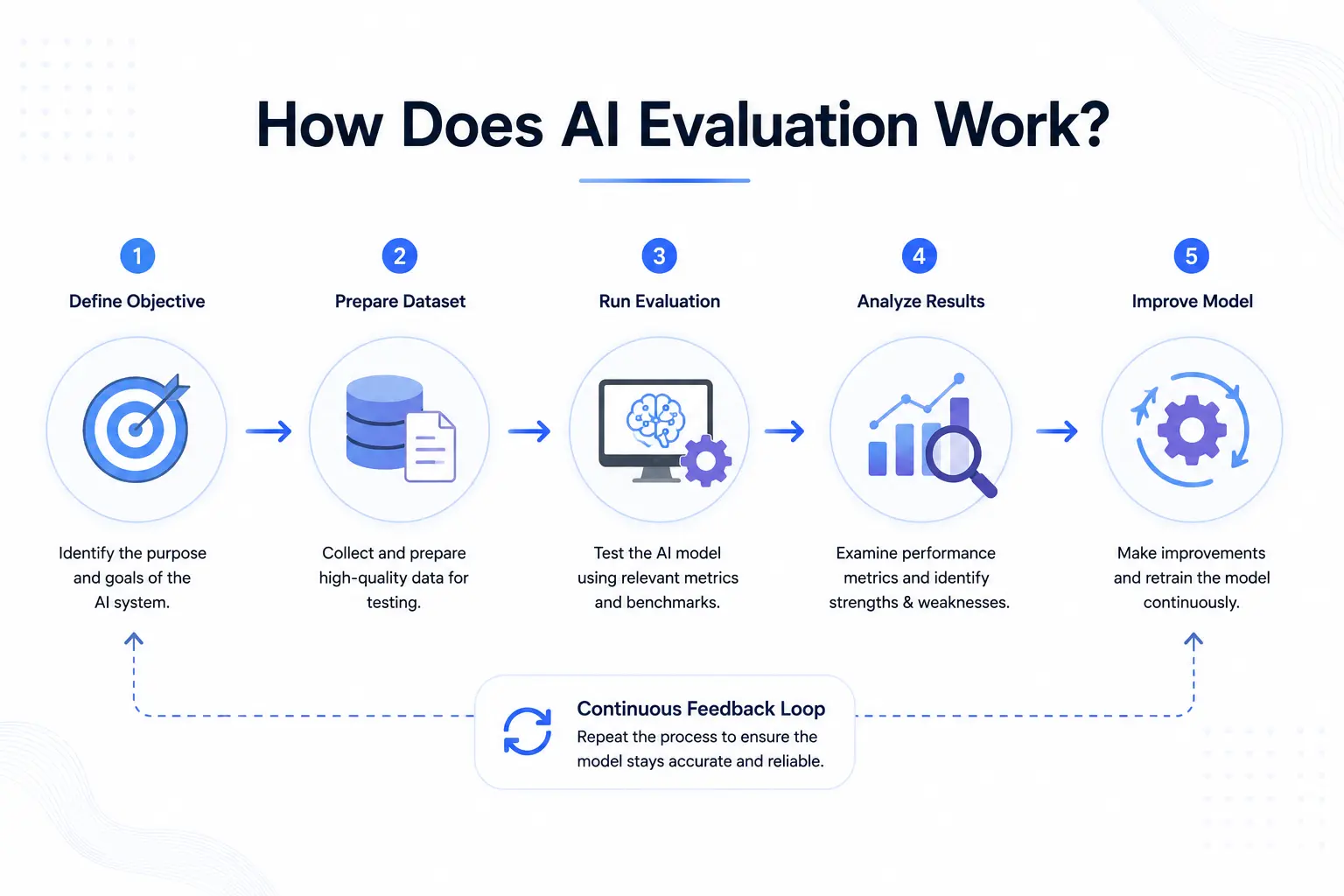
Understanding the concept of evaluation is important, but knowing how developers actually test an AI model provides a much clearer picture of the entire process. Instead of relying on a single test, developers follow a structured workflow that measures different aspects of model performance before releasing it to users. This systematic approach makes AI Evaluation more reliable, helping organizations identify weaknesses, improve model quality, and ensure consistent performance in real-world environments.
Although the exact methodology may vary depending on the application, most AI projects follow the same core evaluation process.
Step 1: Define the Objective
Every AI project begins with a clearly defined objective.
Before testing starts, developers determine exactly what success looks like. For example, a chatbot should answer user questions accurately, an image recognition system should correctly identify objects, while a recommendation engine should suggest products that genuinely match customer interests. Establishing clear goals from the beginning ensures that the AI Evaluation process measures the right outcomes and provides meaningful performance insights.
Without a clear objective, it becomes difficult to determine whether the model is performing successfully.
Step 2: Prepare an Evaluation Dataset
After defining the objective, developers prepare a separate testing dataset that the model has never seen during training.
Using unseen data is essential because it measures how well the model can generalize instead of simply memorizing information from the training dataset. A well-designed evaluation dataset should include both common examples and challenging real-world scenarios, allowing developers to assess how the model behaves under different conditions.
Step 3: Test the Model
The model is then exposed to hundreds, thousands, or even millions of different inputs depending on the application.
Developers observe how the system responds to normal queries, difficult questions, unexpected prompts, incomplete information, and edge cases that rarely occur but could still affect users. This stage helps identify where the model performs well and where additional improvements may be required before deployment, making AI Evaluation more accurate and effective.
Step 4: Measure Performance
After testing is complete, the generated outputs are compared with the expected results.
Developers calculate various performance metrics such as accuracy, precision, recall, consistency, response quality, efficiency, and reliability. These measurements provide a comprehensive understanding of the model’s strengths and weaknesses, helping developers decide whether it is ready for deployment or requires further optimization.
Step 5: Improve and Re-Test
Evaluation is never a one-time activity.
If testing reveals issues such as inaccurate predictions, slow responses, biased outputs, or inconsistent behavior, developers improve the model, update the training data when necessary, and perform another round of testing. This continuous improvement cycle ensures that AI Evaluation remains an ongoing process, enabling AI systems to adapt to changing user needs, maintain high performance, and deliver reliable results even after deployment.
Types of AI Evaluation
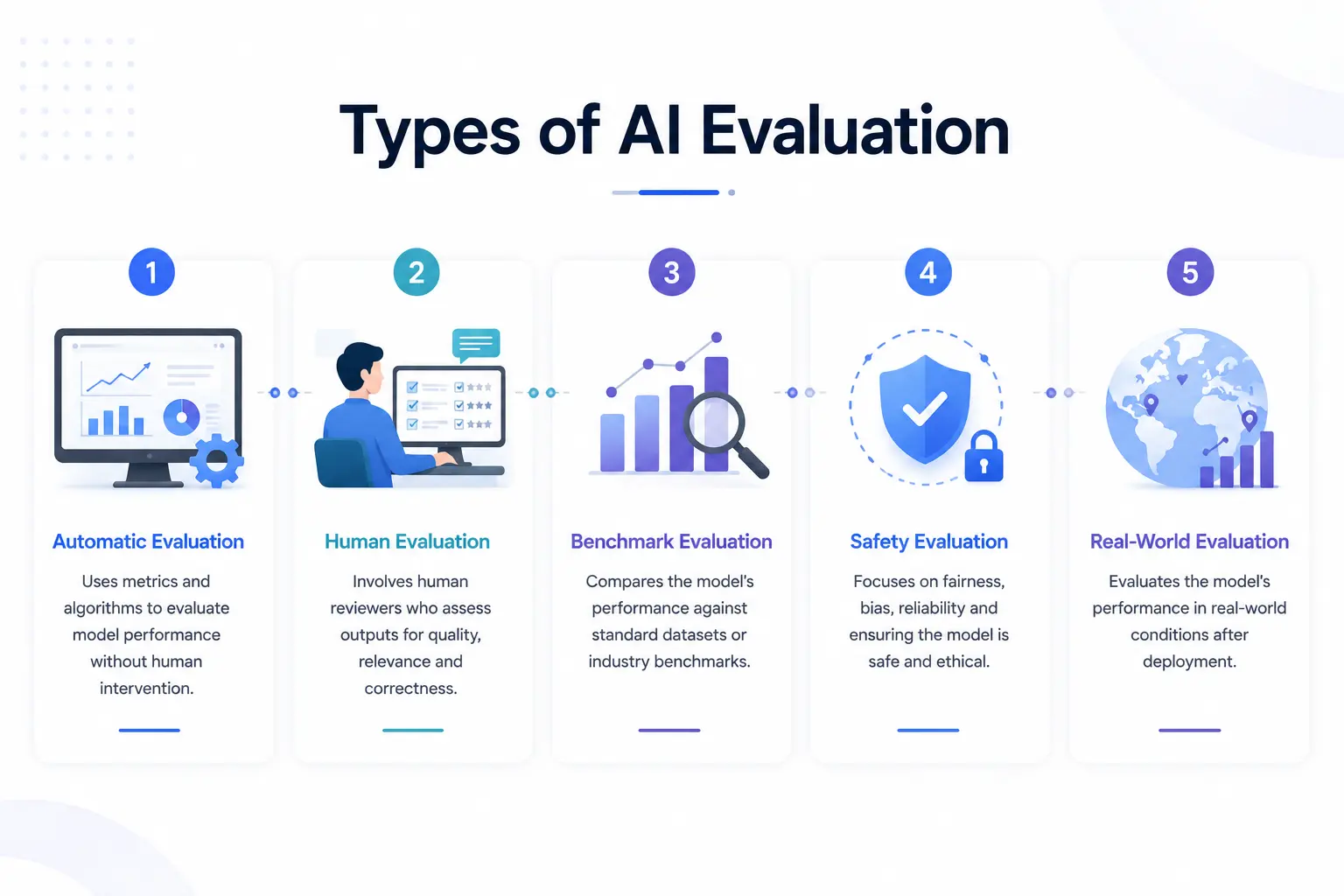
Artificial Intelligence is used across a wide range of industries, including healthcare, finance, education, customer support, e-commerce, cybersecurity, and autonomous vehicles. Since every AI system is designed to solve a different problem, no single evaluation method can accurately measure the performance of every model. Different applications require different testing approaches based on their objectives, complexity, and expected outcomes. This is why AI Evaluation combines multiple evaluation techniques to provide a complete understanding of a model’s accuracy, reliability, safety, and real-world performance.
Below are the most widely used evaluation methods in modern Artificial Intelligence development.
1. Automatic Evaluation
Automatic evaluation uses predefined algorithms, benchmark datasets, and performance metrics to measure how well an AI model performs without requiring direct human involvement.
This method is fast, consistent, and highly scalable, making it ideal for testing large Machine Learning models across thousands or even millions of test cases. Developers can quickly compare different versions of a model, identify performance improvements, and detect potential issues before deployment, making AI Evaluation faster and more efficient.
However, automated testing cannot fully evaluate qualities such as creativity, reasoning ability, emotional understanding, or the natural flow of human conversation. For this reason, it is usually combined with human evaluation to produce more balanced results.
2. Human Evaluation
Some aspects of AI performance cannot be measured through numbers alone.
Human evaluation involves domain experts, reviewers, or real users who assess whether AI-generated responses are accurate, relevant, natural, helpful, and easy to understand. They also evaluate reasoning quality, clarity, factual correctness, and the overall user experience.
This method is especially valuable for conversational AI, virtual assistants, translation tools, content generation platforms, and Large Language Models (LLMs), where user satisfaction is just as important as technical accuracy. Although it requires more time and resources, human evaluation often provides insights that automated testing cannot capture.
3. Benchmark Evaluation
Benchmark evaluation compares an AI model against standardized datasets that are widely accepted by the AI research community.
These benchmarks create a common testing environment, allowing developers to compare different models fairly and objectively. Strong benchmark performance usually indicates that a model has learned useful patterns and performs well across a variety of tasks.
Technology companies frequently use benchmark scores to measure research progress, compare new model versions, and validate improvements. However, achieving excellent benchmark results does not always guarantee outstanding real-world performance, which is why benchmark testing should always be combined with practical AI Evaluation methods.
4. Safety Evaluation
As AI systems become more capable and widely accessible, ensuring safe and responsible behavior has become a major priority.
Safety evaluation examines whether a model can resist harmful prompts, avoid generating offensive or misleading content, protect sensitive information, and follow responsible AI principles. Developers also test how the system responds to malicious attempts that try to bypass built-in safety mechanisms or manipulate its behavior.
This type of evaluation has become increasingly important for generative AI systems that interact directly with millions of users every day.
5. Real-World Evaluation
Successfully passing internal tests is only one stage of an AI model’s lifecycle.
After deployment, developers continue monitoring how the model performs in real-world environments by analyzing user feedback, response quality, system stability, operational metrics, and changing usage patterns. This ongoing assessment helps identify new challenges that may not have appeared during laboratory testing, making AI Evaluation a continuous process rather than a one-time activity.
Continuous monitoring enables organizations to improve models over time, adapt to evolving user expectations, and maintain consistent performance under changing conditions. As AI technology continues to evolve, real-world evaluation remains one of the most valuable stages of building reliable and trustworthy Artificial Intelligence systems.
Key Metrics Used to
Measure AI Performance
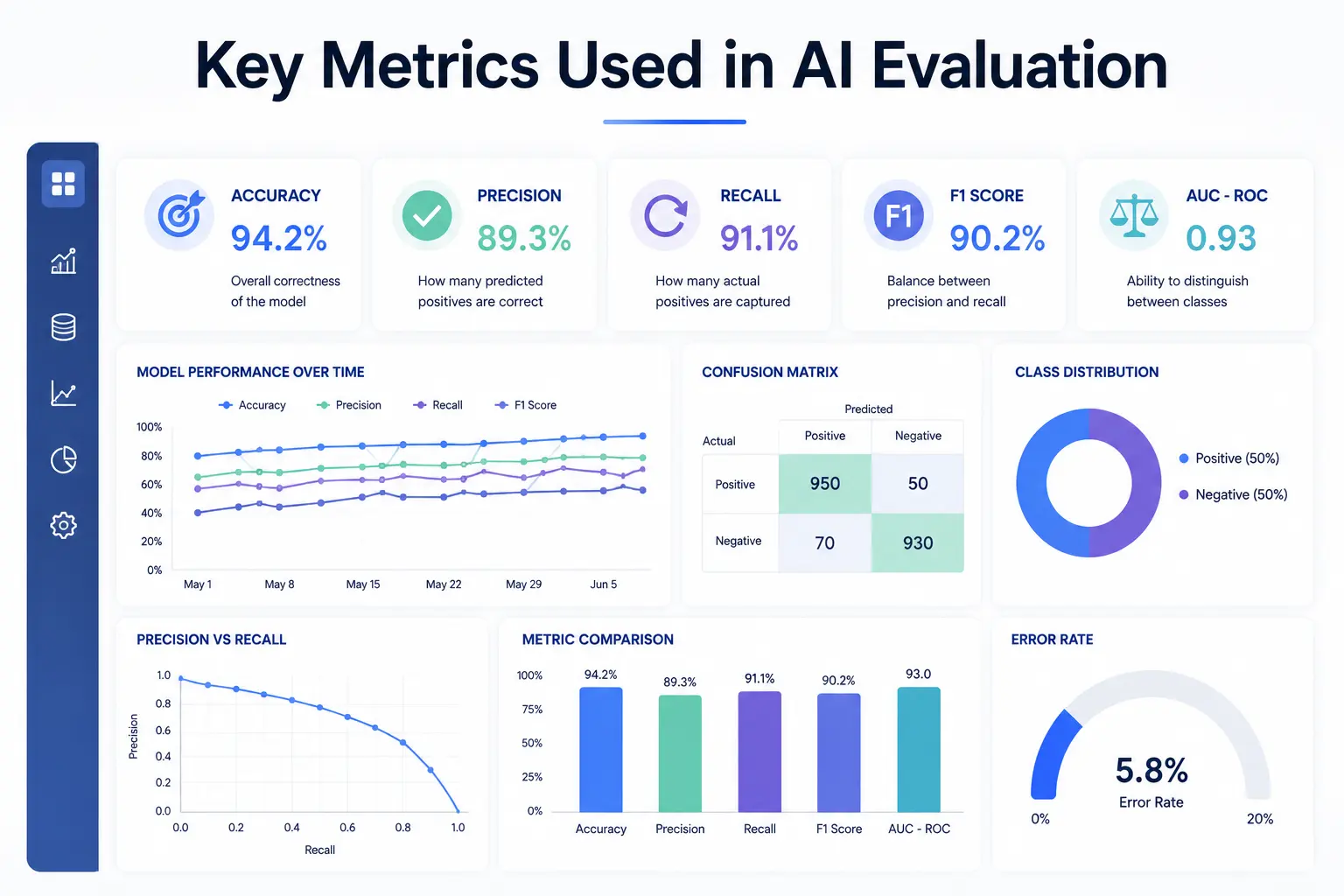
Measuring an AI model’s performance is one of the most important stages of the development process. Without clear performance metrics, developers cannot accurately determine whether a model is ready for real-world deployment. Instead of relying on assumptions, they use standardized measurements to evaluate how effectively a model performs different tasks under various conditions. These metrics provide valuable insights into a model’s strengths, weaknesses, and areas that require improvement, making AI Evaluation a more reliable and data-driven process.
The choice of metric depends on the type of AI application. For example, an image recognition system, a recommendation engine, and a conversational chatbot all require different evaluation approaches. However, several performance metrics are widely accepted across the Artificial Intelligence industry because they provide a comprehensive understanding of model quality.
Accuracy
Accuracy measures the percentage of correct predictions made by an AI model compared to the total number of predictions. It is one of the simplest and most widely used metrics, particularly for classification tasks such as image recognition, spam detection, and sentiment analysis.
Although high accuracy often indicates strong overall performance, it should not be used as the only measurement because some real-world applications require a more detailed evaluation.
Precision
Precision measures how many of the positive predictions generated by an AI model are actually correct.
This metric becomes especially important in applications where false positives can create serious problems, such as fraud detection, cybersecurity, email spam filtering, and financial risk analysis.
A high precision score indicates that the model makes fewer incorrect positive predictions, improving the reliability of its decisions and contributing to more effective AI Evaluation.
Recall
Recall evaluates how effectively an AI model identifies all relevant cases within a dataset.
This metric is particularly valuable in healthcare, where missing a disease diagnosis could have far more serious consequences than generating an occasional false positive. A high recall score shows that the model successfully identifies most of the important cases that require attention.
F1 Score
The F1 Score combines Precision and Recall into a single performance measurement.
Rather than focusing on only one aspect of model performance, it provides a balanced assessment when both false positives and false negatives are equally important. Because of this balance, the F1 Score has become one of the most widely used metrics in Machine Learning and AI Evaluation projects.
Response Quality
For conversational AI systems, measuring response quality is just as important as measuring prediction accuracy.
Developers evaluate whether AI-generated responses are factually correct, contextually relevant, grammatically accurate, easy to understand, and genuinely helpful to users. Since these qualities cannot always be measured using numerical metrics alone, automated testing is often combined with expert human review to obtain a more complete assessment.
Consistency
A reliable AI system should deliver consistent results whenever users provide similar inputs.
Consistency helps build user confidence because people expect dependable answers regardless of when, where, or how they interact with an AI application. Measuring consistency also allows developers to identify unstable behavior that may appear only under specific scenarios or changing conditions.
Real-World Applications of AI Evaluation
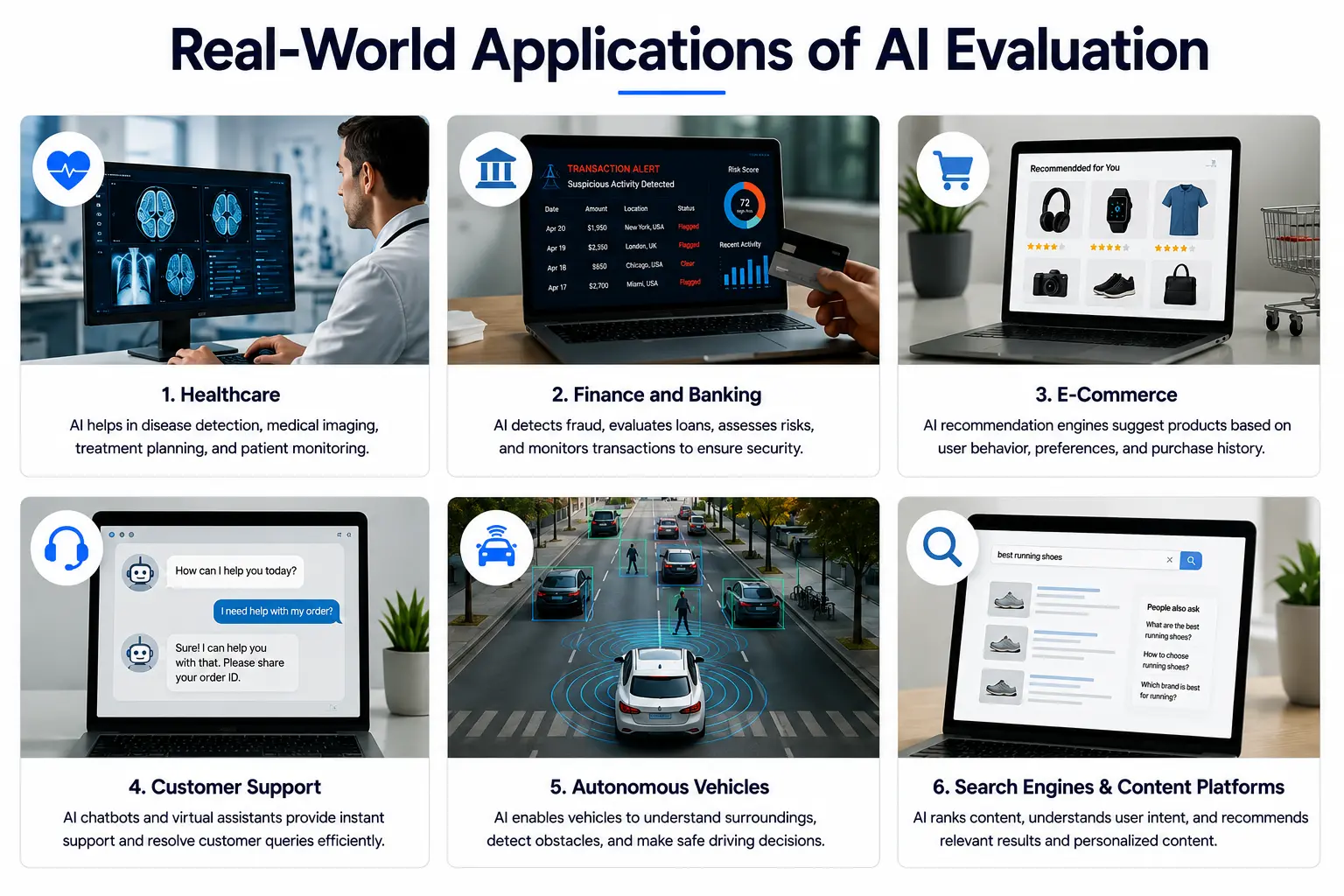
Artificial Intelligence is no longer limited to research laboratories or large technology companies. Today, AI powers thousands of applications across industries, helping organizations improve efficiency, automate repetitive tasks, and make smarter decisions. However, before these systems are deployed, developers must ensure that they perform accurately and reliably in practical environments.
This is where AI Evaluation becomes essential. By continuously testing AI models, organizations can reduce risks, improve performance, and deliver trustworthy solutions to users.
Below are some of the most common industries where AI evaluation plays a critical role.
1. Healthcare
AI is transforming healthcare by assisting doctors with disease detection, medical imaging, treatment planning, and patient monitoring. Since healthcare decisions directly affect human lives, even small errors can have serious consequences.
Developers thoroughly evaluate medical AI systems to verify diagnostic accuracy, reduce false predictions, and ensure that recommendations remain reliable across different patient groups. AI Evaluation plays a critical role in helping healthcare providers deliver safer and more accurate patient care.
2. Finance and Banking
Banks and financial institutions use AI to detect fraudulent transactions, evaluate loan applications, assess financial risks, and monitor suspicious activities.
Proper testing ensures that these systems identify genuine fraud while minimizing false alerts that could inconvenience customers or delay legitimate transactions.
3. E-Commerce
Online shopping platforms rely heavily on AI-powered recommendation engines.
These systems analyze customer preferences, browsing history, and purchase behavior to recommend products that users are more likely to buy.
Evaluation helps improve recommendation quality, increase customer satisfaction, and boost conversion rates.
4. Customer Support
Many organizations now use AI chatbots and virtual assistants to provide instant customer support.
Before deployment, these systems are tested to ensure they understand user questions correctly, provide relevant answers, and maintain natural conversations across different scenarios.
Continuous monitoring also helps improve chatbot performance as customer behavior changes over time, making AI Evaluation essential for delivering a better customer experience.
5. Autonomous Vehicles
Self-driving vehicles use AI to recognize traffic signs, pedestrians, road conditions, nearby vehicles, and unexpected obstacles.
Because passenger safety depends on these decisions, developers conduct extensive testing under different weather conditions, road environments, and traffic situations before releasing autonomous driving systems.
6. Search Engines and Content Platforms
Search engines use Artificial Intelligence to rank webpages, understand user intent, and deliver relevant search results.
Similarly, streaming services and social media platforms evaluate recommendation algorithms to improve content discovery while maintaining accuracy and user satisfaction.
Across every industry, continuous testing helps organizations deliver AI systems that remain accurate, dependable, and capable of adapting to changing real-world conditions. This is why AI Evaluation remains an essential part of building reliable, trustworthy, and high-performing AI solutions.
Common Challenges in AI Evaluation
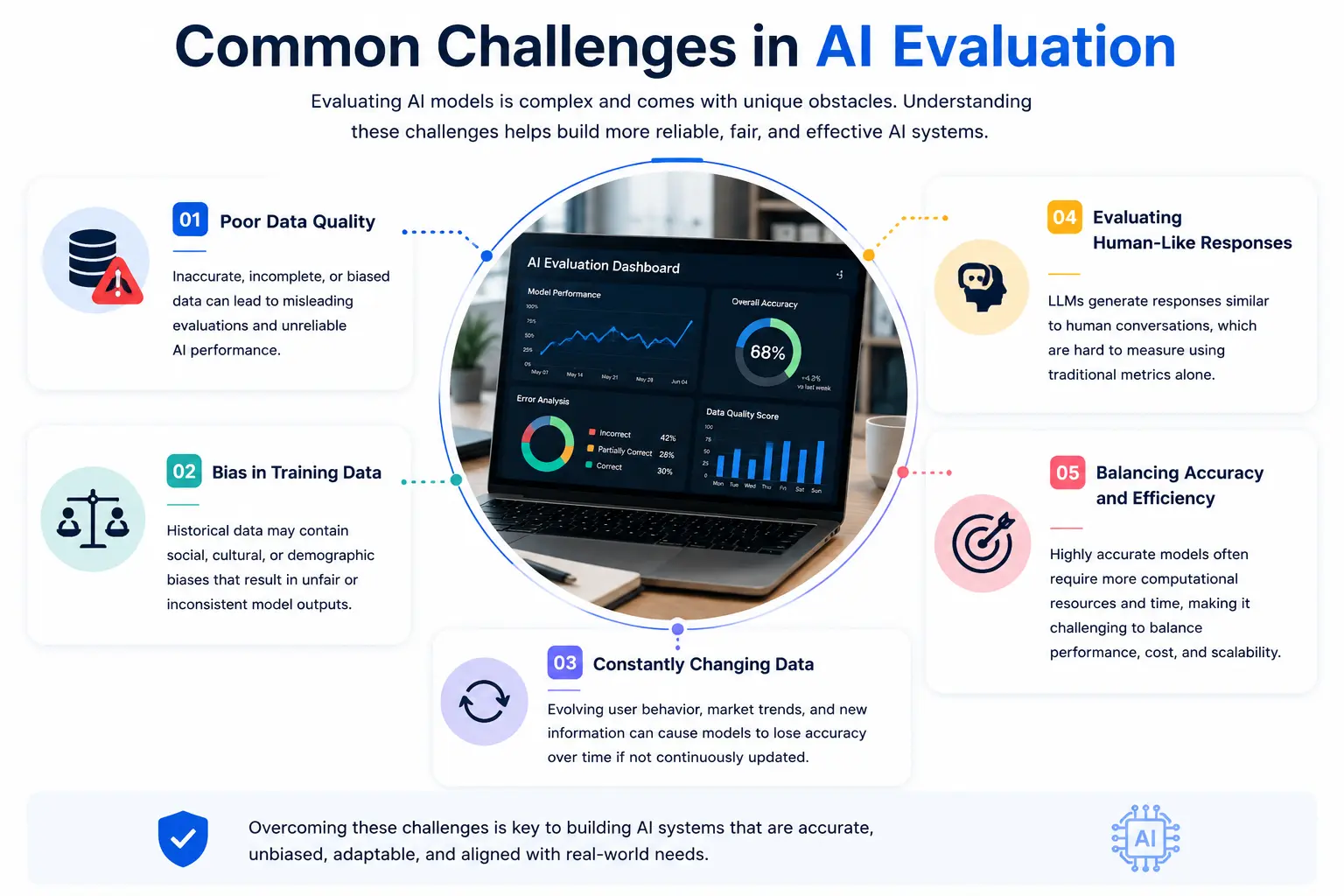
Although Artificial Intelligence has made remarkable progress over the past few years, evaluating modern AI systems remains a complex and evolving process. Today’s AI models learn from massive datasets, process billions of data points, and operate in constantly changing environments. As these systems become more advanced, accurately measuring their performance becomes increasingly challenging. This is why AI Evaluation requires a combination of technical expertise, high-quality data, and continuous monitoring to ensure reliable and trustworthy results.
Below are some of the most common challenges developers face while evaluating AI models.
1. Poor Data Quality
The accuracy of an evaluation depends largely on the quality of the testing dataset. If the evaluation data is incomplete, outdated, inaccurate, or biased, the final results may not reflect how the model will behave in real-world situations.
To obtain meaningful insights, developers should use diverse and representative datasets that include different user behaviors, environments, languages, and edge cases. High-quality testing data provides a more realistic picture of the model’s strengths, weaknesses, and overall performance before deployment.
2. Bias in Training Data
AI models learn from historical data, and that information may unintentionally contain social, cultural, or demographic biases. If these biases remain undetected during testing, the model may generate unfair recommendations or produce inconsistent results for different groups of users.
To reduce this risk, developers regularly monitor model behavior, improve training datasets, and evaluate outputs across diverse scenarios. Identifying and correcting bias has become an essential part of responsible AI Evaluation, helping organizations build fairer and more inclusive AI systems.
3. Constantly Changing Data
The digital world never remains the same. Customer preferences evolve, languages change, market trends shift, and new information becomes available every day. As a result, an AI model that performs exceptionally well today may gradually lose accuracy if it is not reviewed and updated regularly.
Continuous monitoring allows organizations to detect performance issues early, retrain models with fresh data, and maintain consistent results as real-world conditions continue to evolve.
4. Evaluating Human-Like Responses
Modern Large Language Models (LLMs) generate responses that closely resemble natural human conversation. Unlike traditional prediction models, these systems must be evaluated for reasoning ability, factual accuracy, clarity, relevance, creativity, and overall user satisfaction.
Because these qualities cannot always be measured through automated metrics alone, many organizations combine software-based testing with expert human reviewers to obtain a more balanced and reliable assessment.
5. Balancing Accuracy and Efficiency
Highly accurate AI models often require greater computing power, longer processing times, and increased operational costs. On the other hand, models optimized for speed may sacrifice response quality or accuracy.
Developers must carefully balance performance, scalability, efficiency, and resource consumption to select the most practical solution for real-world deployment. A well-planned AI Evaluation strategy helps organizations achieve this balance while ensuring that AI systems remain reliable, cost-effective, and capable of delivering consistent performance over time.
Best Practices for Effective
AI Evaluation
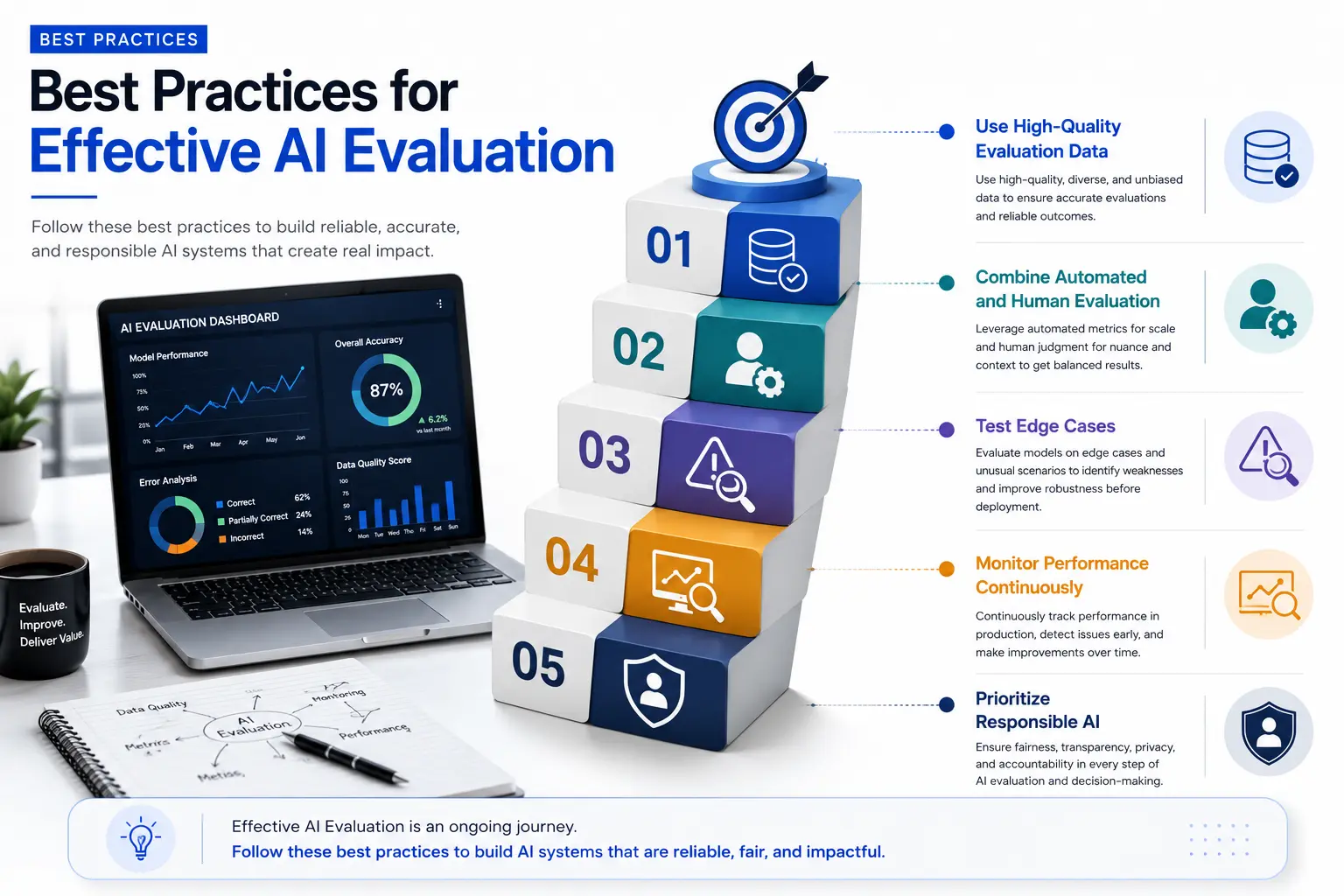
Developing an AI model is only the first step in building a successful Artificial Intelligence solution. The real challenge begins after deployment, when the model starts interacting with real users and continuously receives new types of data. A system that performs well during development may gradually lose accuracy if it is not monitored and improved regularly. This is why AI Evaluation should be viewed as an ongoing process rather than a one-time task. Leading technology companies continuously assess model performance, identify weaknesses, and refine their systems to ensure long-term reliability, safety, and user satisfaction.
Below are some of the most effective practices followed by AI researchers and industry leaders to build dependable and high-performing AI systems.
1. Use High-Quality Evaluation Data
The quality of any evaluation depends heavily on the quality of the testing data. If developers use incomplete, outdated, or biased datasets, the results may not accurately reflect how the model will perform in real-world situations. To achieve reliable outcomes, testing data should represent different user behaviors, demographics, languages, environments, and challenging edge cases. For example, a healthcare AI system should be evaluated using patient data from diverse age groups and regions instead of relying on a limited dataset. High-quality testing provides a realistic understanding of both the strengths and limitations of a model, making AI Evaluation far more accurate and meaningful before deployment.
2. Combine Automated and Human Review
Automated testing allows developers to measure objective performance indicators such as accuracy, precision, recall, response time, and consistency within a short period. However, numbers alone cannot determine whether an AI-generated response feels natural, contextually relevant, or genuinely useful to users. Human reviewers play an equally important role by assessing reasoning quality, clarity, factual correctness, tone, and overall user experience. Combining automated analysis with expert human feedback creates a more balanced assessment and helps developers identify issues that software-based metrics might overlook. This combination has become a standard practice in modern AI Evaluation workflows.
3. Test Real-World and Edge-Case Scenarios
Users rarely interact with AI systems in perfectly predictable ways. They often ask incomplete questions, use informal language, make typing mistakes, or provide unexpected prompts that developers may not have anticipated during training. If these situations are ignored, an AI model may perform well in controlled environments but fail when used by real people. To avoid this, developers should test both common user interactions and uncommon edge cases that challenge the model’s reasoning and adaptability. Evaluating these scenarios helps uncover hidden weaknesses early and improves the overall reliability of the system before large-scale deployment.
4. Monitor Performance After Deployment
Launching an AI application should never mark the end of the evaluation process. User behavior, market trends, languages, and available information continue to evolve, meaning model performance can gradually decline over time. Organizations should regularly monitor user feedback, error reports, response quality, and operational metrics to identify areas that need improvement. Continuous monitoring makes it possible to retrain models, update datasets, and resolve performance issues before they significantly affect users. Ongoing AI Evaluation ensures that AI systems remain accurate, reliable, and capable of adapting to changing real-world conditions throughout their lifecycle.
5. Build Responsible and Trustworthy AI
Technical performance alone is not enough to create a successful AI solution. Modern AI systems must also be fair, transparent, secure, and respectful of user privacy. Developers should regularly examine models for potential bias, protect sensitive information, generate safe responses, and comply with responsible AI principles throughout the development lifecycle. Organizations that prioritize ethical practices not only reduce potential risks but also strengthen user confidence by following responsible AI guidelines, By combining responsible development with continuous AI Evaluation, businesses can create AI systems that remain dependable, adaptable, and valuable while maintaining long-term trust among users.
The Future of AI Evaluation
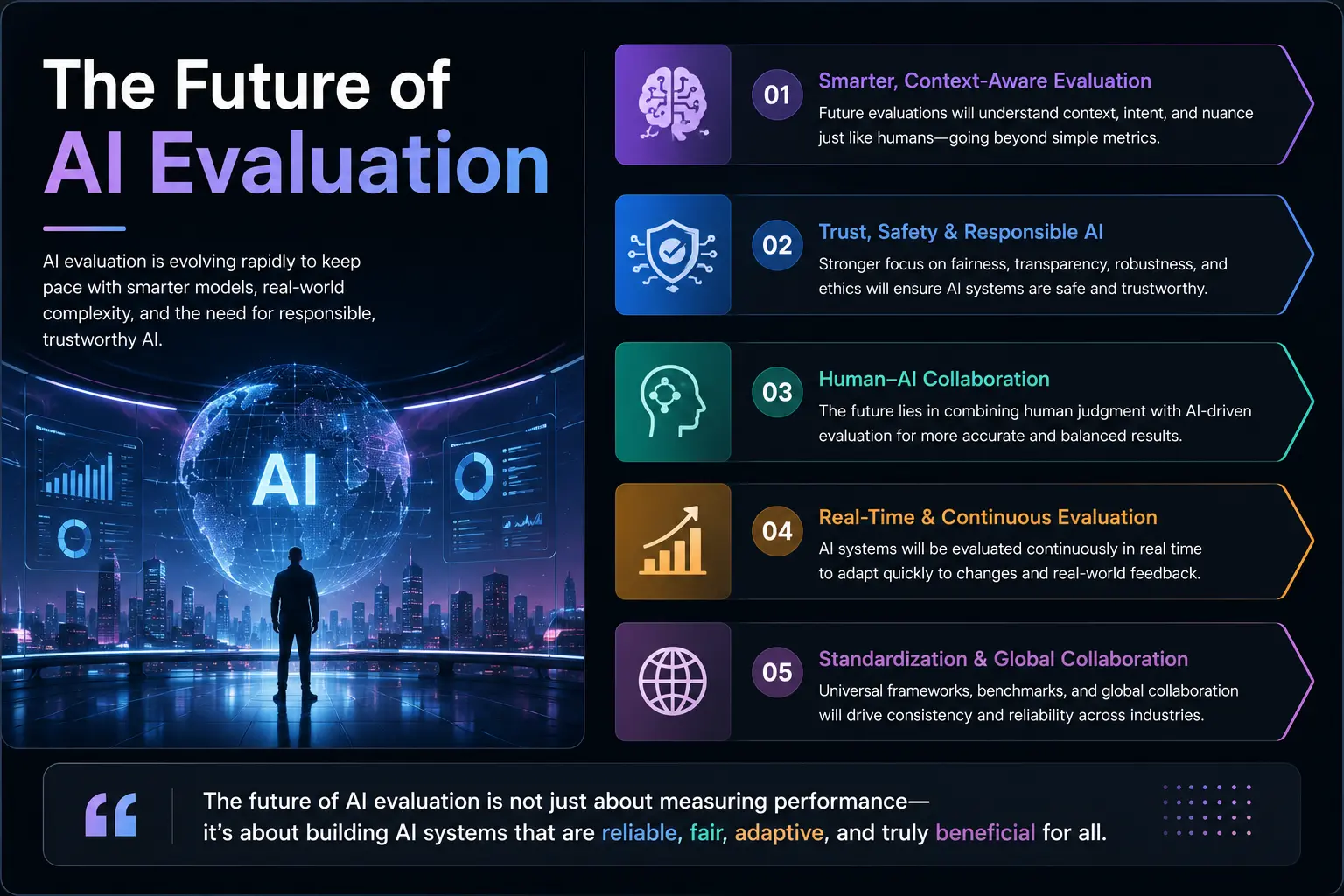
Artificial Intelligence continues to evolve at an extraordinary pace, and evaluation methods are advancing alongside it.
Future AI systems will become more intelligent, capable of handling complex reasoning, understanding multiple forms of data, and assisting humans in increasingly sophisticated tasks. As these capabilities expand, the methods used to evaluate AI will also become more comprehensive.
Researchers are already developing advanced benchmark datasets, automated evaluation frameworks, continuous monitoring systems, and real-time performance analysis tools that provide deeper insights into model behavior.
Greater attention is also being given to reducing hallucinations, improving factual accuracy, detecting hidden bias, protecting user privacy, strengthening security, and ensuring compliance with ethical AI standards.
In the coming years, organizations will focus not only on building more powerful AI models but also on creating systems that are transparent, trustworthy, and accountable. Continuous evaluation will remain a key factor in achieving that goal.
Conclusion
Artificial Intelligence is transforming the way people work, communicate, learn, and solve complex problems. However, the success of any AI system depends not only on how well it is trained but also on how carefully it is tested before reaching users.
A well-planned AI Evaluation process helps developers measure accuracy, reliability, fairness, safety, and overall performance across different real-world scenarios. It also enables organizations to identify weaknesses early, improve model quality, reduce operational risks, and build greater confidence among users.
As Artificial Intelligence continues to expand into industries such as healthcare, finance, education, manufacturing, transportation, and customer service, continuous evaluation will become even more important. Organizations that invest in regular testing and ongoing improvement will be better positioned to deliver AI solutions that remain accurate, secure, and dependable over time.
Rather than treating evaluation as the final step in development, businesses should view it as a continuous cycle of testing, learning, refining, and improving. This approach not only enhances technical performance but also helps create responsible AI systems that people can trust with confidence.
Related Articles
Want to learn more about AI, SEO, and digital marketing strategies? Explore our latest blogs and stay ahead with practical insights, industry updates, and growth-focused knowledge.
Top 10 Digital Marketing Tips for Small Businesses
If you want to learn how to grow your small business online, attract more customers, and increase brand visibility, this practical guide is the perfect place to start.
Top 12 SEO Tips For Beginners Every Beginner Should Know
If you want to learn the fundamentals of SEO and discover proven techniques to improve Google rankings and organic traffic, don’t miss this beginner-friendly guide.
20 Google Algorithm Updates Every Beginner Should Know
If you want to learn how Google’s biggest algorithm updates have changed SEO and search rankings over the years, explore this complete guide.
Frequently Asked Questions (FAQs)
1. What is AI Evaluation in simple words?
AI Evaluation is the process of testing an Artificial Intelligence model to measure its accuracy, reliability, safety, and overall performance before and after deployment.
2. Why is AI Evaluation important?
It helps developers identify errors, improve model quality, reduce bias, enhance safety, and ensure that AI systems perform reliably in real-world situations.
3. What are the most common AI evaluation metrics?
Some widely used metrics include Accuracy, Precision, Recall, F1 Score, Response Quality, Consistency, Reliability, and Latency.
4. Is evaluation performed only before deployment?
No. AI systems should be monitored continuously after deployment because user behavior, datasets, and real-world conditions change over time.
5. Can AI Evaluation reduce bias?
Yes. Regular testing helps developers identify biased behavior, improve training data, and build AI systems that produce fairer and more balanced results.